Is IPTV Legal in the USA? Everything You Need to Know
in the USA?
Everything You Need to Know [2026]
ProviderIPTV · provideriptv.us
Is IPTV legal? That is the single most common question people ask before subscribing to an Internet Protocol Television service in the United States. The short answer is that IPTV as a technology is completely legal — services like YouTube TV, Hulu + Live TV, and Sling TV are all forms of IPTV. The longer answer depends on whether a particular provider is distributing content with proper licensing. This guide from Provider IPTV breaks down what US law actually says, where the gray areas are, and how to make sure you are on the right side of the law.
Disclaimer: this article is for informational purposes only and does not constitute legal advice. Consult a qualified attorney for guidance on your specific situation.
Jump to: The technology · US copyright law · Protecting Lawful Streaming Act · Gray areas · Choosing a legit provider · FAQ
Is IPTV legal? Understanding the technology
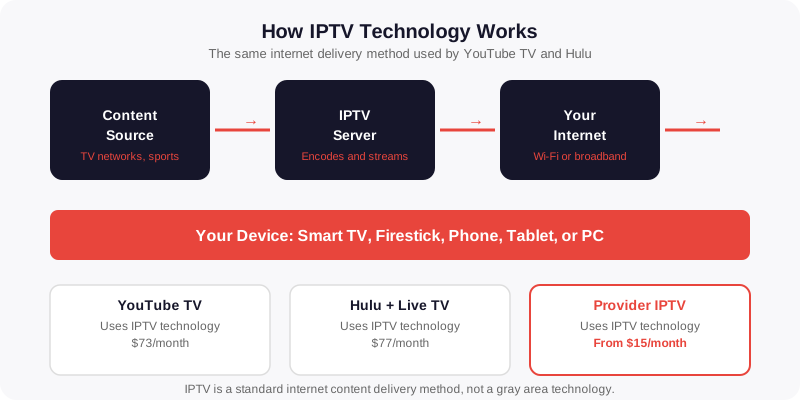
IPTV stands for Internet Protocol Television. Instead of receiving television signals through a traditional cable line, satellite dish, or antenna, IPTV delivers video content over an internet connection using the same packet-switching protocol that powers every website you visit.
The technology itself is entirely neutral — and entirely legal. Major corporations use IPTV to deliver their services every day:
- YouTube TV — the Google live TV streaming service delivers 100+ channels via IPTV.
- Hulu + Live TV — the Disney live streaming option uses IPTV infrastructure.
- Sling TV — one of the original cord-cutting IPTV services, operated by Dish Network.
- DirecTV Stream — AT&T replaced its satellite service with an IPTV-based platform.
- FuboTV — a sports-focused IPTV service with major broadcast deals.
When someone asks “is IPTV legal,” they are usually not asking about the technology. They are asking about specific third-party services that offer thousands of channels at prices far below what the major providers charge. The legality question centers on content licensing, not on the delivery method.
Is IPTV legal under US copyright law?
US copyright law — primarily the Copyright Act of 1976, codified at 17 U.S.C. — grants content owners exclusive rights to reproduce, distribute, and publicly perform their works. Broadcasting or restreaming copyrighted television content without a license from the rights holder is a violation of federal law.
Here is a side-by-side comparison of what separates legal IPTV services from unlicensed ones:
| Characteristic | Licensed / Legal IPTV | Unlicensed / Illegal IPTV |
|---|---|---|
| Content licensing | Holds broadcast licenses from networks and studios | No licensing agreements; restreams without permission |
| Price range | $35-$75+/month for major services | Often $5-$20/month for thousands of channels |
| Channel count | 50-200 channels per market | Claims of 10,000-100,000+ channels worldwide |
| Corporate entity | Registered US business with public filings | Anonymous operators, offshore entities, no public records |
| Payment methods | Standard credit cards, PayPal, Google Pay | Crypto-only or anonymous payment methods common |
| App availability | Official apps in Apple App Store and Google Play | Requires sideloading or third-party apps |
| Legal risk to user | None | Low for individual viewers, but service may disappear overnight |
It is important to understand that US copyright law primarily targets distributors of unlicensed content rather than individual viewers. However, using a service that you know is distributing pirated content does carry risk — and the service itself could be shut down at any time, meaning you lose your subscription and your money.
Is IPTV legal? The Protecting Lawful Streaming Act explained
In December 2020, Congress passed the Protecting Lawful Streaming Act (PLSA) as part of the Consolidated Appropriations Act of 2021. This law significantly changed the legal landscape for unauthorized IPTV services in the United States.
Before the PLSA, illegally streaming copyrighted content was only a misdemeanor under federal law, even at a commercial scale. The PLSA upgraded commercial-scale pirate streaming to a felony offense. Here are the key provisions:
- Targets commercial operations — the law applies to services that stream copyrighted content for commercial advantage or private financial gain. It does not target individual viewers or casual users.
- Felony penalties — operators of commercial pirate streaming services face up to 5 years in prison for a first offense and up to 10 years for repeat offenders.
- Defines “streaming” — the law specifically covers the transmission of copyrighted works via the internet, closing a loophole that previously treated streaming differently from downloading.
- Does not criminalize viewers — the PLSA explicitly does not create liability for individuals who simply access or watch pirated streams. The targets are the operators running the services.
Since the PLSA took effect, federal authorities have shut down several large-scale pirate IPTV operations. The law gives the Department of Justice a much stronger tool to pursue commercial piracy rings operating within or targeting the US market.
For consumers, the practical impact is this: the services most likely to be shut down are the ones operating without licenses. When a service goes dark, subscribers lose access and have no legal recourse to recover their payments.
Is IPTV legal? Gray areas and common misconceptions
The IPTV legality question is not always black and white. Here are several gray areas and misconceptions that come up frequently:
Misconception: “If a service has a website and accepts credit cards, it must be legal.”
Having a professional website and standard payment processing does not guarantee that a service holds content licenses. Some unlicensed providers invest heavily in marketing and customer experience while still distributing content illegally. Payment processors may not be aware of what the service is actually delivering.
Misconception: “Using a VPN makes everything legal.”
A VPN encrypts your internet traffic and masks your IP address, but it does not change the legal status of the content you are accessing. Using a VPN is legal in the United States, but it does not make an illegal service legal.
Misconception: “Personal use is always protected.”
Fair use under US copyright law has four factors, and personal viewing of pirated streams does not qualify as fair use. That said, enforcement has historically focused on distributors, not individual viewers.
Gray area: services operating from outside the US
Many IPTV services are operated from countries where enforcement is limited. While the service itself may be violating US copyright law, pursuing operators in foreign jurisdictions is challenging. This does not make the service legal — it means enforcement is difficult.
Gray area: “rebroadcasting” free-to-air channels
Some IPTV services claim they only offer channels that are free-to-air (broadcast over antenna). While those channels are free to receive via antenna in the US, retransmitting them over the internet without authorization from the broadcaster still requires a license under the Copyright Act.
For a list of providers that prioritize transparency and legitimacy, see our legal IPTV providers in the USA guide.
Is IPTV legal? How to choose a legitimate provider
Whether you are looking at major streaming services or smaller IPTV providers, here is a checklist to help you evaluate legitimacy and reduce your risk:
Legitimacy checklist for IPTV providers
- Real business identity — the provider has a registered business name, physical or verifiable address, and contact information beyond just a Telegram or WhatsApp number.
- Professional website with terms of service — legitimate providers publish clear terms, privacy policies, and refund policies on their website.
- Standard payment methods — credit card, PayPal, and other mainstream payment processors. Crypto-only payment is a warning sign.
- Reasonable channel count and pricing — if a service offers 100,000 channels for $10/month, the math does not work. Content licensing is expensive.
- Money-back guarantee — providers that stand behind their service offer refund windows. This shows confidence in the product and accountability to customers.
- Responsive customer support — live chat, email support, or phone support that actually responds. Ghost support is a red flag.
- Compatible with major apps — works with established IPTV apps like IPTV Smarters, TiviMate, and GSE Smart IPTV rather than requiring a proprietary app with unknown origins.
- Consistent online presence — the service has been operating for more than a few months and has verifiable reviews or mentions across multiple platforms.
Provider IPTV meets every item on this checklist. We offer 55,000+ channels and 150,000+ VOD titles in up to 4K quality, support all major apps (IPTV Smarters, TiviMate, GSE Smart IPTV) on every device (Firestick, Android, Smart TV, iOS, Apple TV, MAG, PC), provide 24/7 customer support, and back every subscription with a 7-day money-back guarantee. Plans start at $19/month for a single month, with our 12-month plan coming in at just $6.58/month ($79/year).
For an in-depth look at what makes a provider dependable, read our how to find a reliable IPTV provider guide.
Is IPTV legal FAQ
Choose a provider you can trust
55,000+ channels. 150,000+ VOD. 4K quality. 24/7 support. 7-day money-back guarantee. Plans from $6.58/mo.
Is IPTV legal FAQ
Is IPTV legal in the United States?
Can I get in trouble for using an IPTV service?
How do I know if an IPTV provider is operating legally?
Is IPTV legal compared to cable TV and satellite?
Will my ISP block IPTV or report me for using it?
Is IPTV legal for watching live sports in the US?
Ready to try the best IPTV in the USA?
55,000+ channels. Plans from $6.58/mo. 7-day money-back guarantee.
See pricing